
Find Des Plaines Residents
A useful Des Plaines residents directory begins with the kind of fact already known. An address points first to Cook County property tools. A full name can be tested in the voter registration form, land-record index, court docket, or a historical collection. An old address belongs in the library and deed trail. Each source answers a narrow question, so no single match proves where every member of a household lives. Owners, taxpayers, registered voters, parties to deeds, and court parties are different groups.
Keep the first result as a lead, then compare it with a second official source. A parcel identification number, or PIN, is often the strongest bridge between an address, a map, a tax card, and a deed. When an online system ends, the correct next stop may be a clerk counter, a courthouse terminal, a mailed form, microfilm, or an Illinois Freedom of Information Act request.
- Search the Cook County Assessor by address and save the PIN, property location, and tax-mailing clues.
- Use the Illinois registration lookup only with the required name, birth date, ZIP, and street facts.
- Search the Cook County Clerk recording index for deeds, liens, plats, and other instruments tied to that name or parcel.
- Check Des Plaines Public Library directories, newspapers, and Des Plaines Memory for older households.
- Ask the actual custodian for the file when the public portal has no scan, no old year, or no search mode.
Des Plaines Records Custodians
Des Plaines is not the Cook County seat, and City Hall does not keep every resident record. The City Clerk holds council and municipal records and serves as the local FOIA route. Cook County offices handle land recordings, property assessment, local vital records, elections, and Circuit Court files. Illinois agencies keep statewide registration, vital, archive, license, and confidentiality programs. Use the office that created the record. For a full address-first method, the Des Plaines street directory follows a parcel from the city portal through county records.
Search Des Plaines Property Records
The Cook County Assessor address search accepts a house number, street direction, street name, and street suffix. Results lead to a property card with the PIN, class, characteristics, assessed values, exemptions, tax details, and neighborhood sales. A property location is the parcel's situs address, meaning the place where the property sits. The separate tax-mailing address may belong to an owner, agent, trust, or business and is not proof of residence.
The CookViewer map helps resolve nearby candidates and shows parcel shape, districts, aerial context, and comparable properties. It can print a map and export selected data. Start from the exact parcel rather than assuming that one street number equals one household.
| Search field | How to enter it |
|---|---|
| House number | Use the numeric portion of the property address. |
| Direction | Choose the prefix only when the address uses one. |
| Street name | Enter the core name without adding the suffix. |
| Suffix | Select Street, Avenue, Road, or the listed type. |
| PIN | Use the county parcel number when an address is uncertain. |
The manifest image comes from the Cook County Assessor address search.
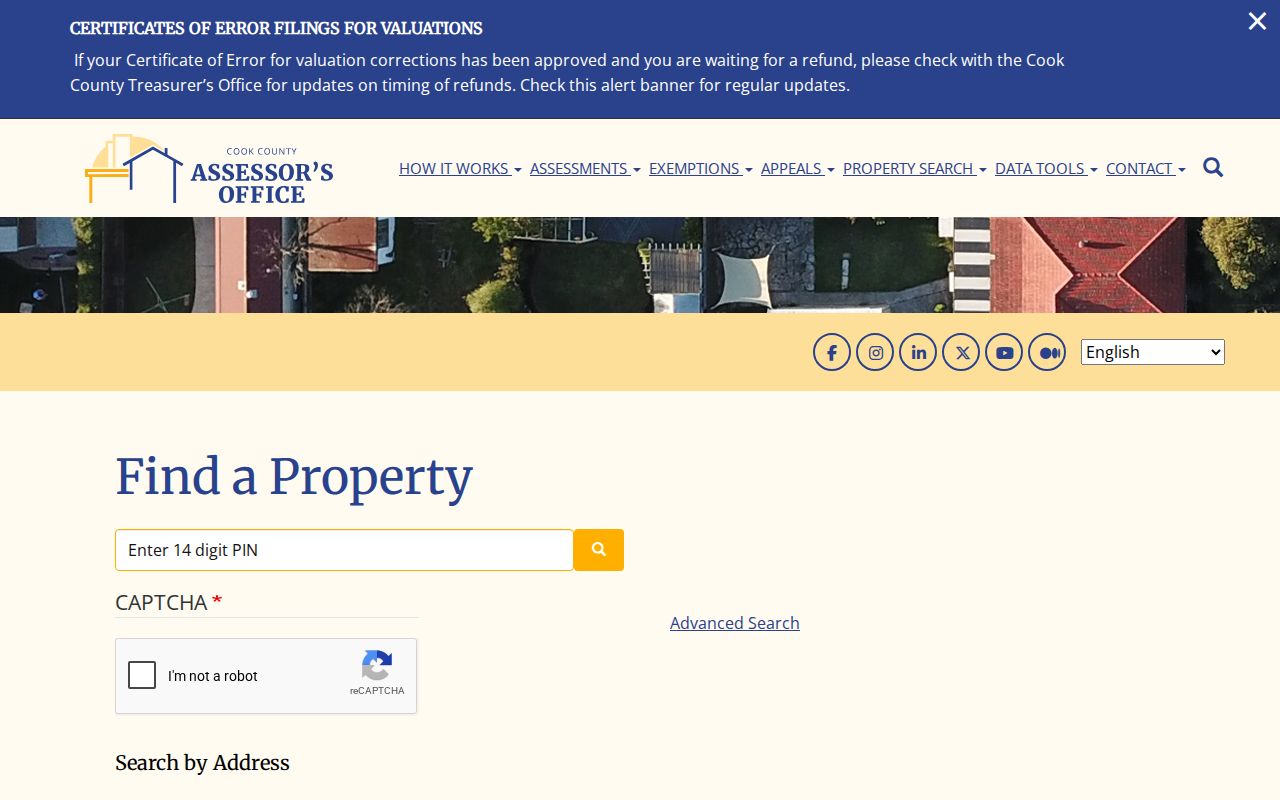
Its separate address parts show why spelling, direction, and suffix should be checked before treating a blank result as final.
Map Des Plaines Resident Clues
CookViewer supplies the geography that a name index lacks. Search an address, inspect the PIN and parcel boundary, then compare nearby lots and district layers. The map may return more than one property within roughly 100 feet, especially near condos, split parcels, or an imprecise address. Match the PIN and legal description before moving into deeds. Recent CookViewer 3.1 work improved mobile use, printing, comparable search, and multi-parcel selection, though live layer names and refresh dates can change.
Open the CookViewer parcel map before searching a whole block.
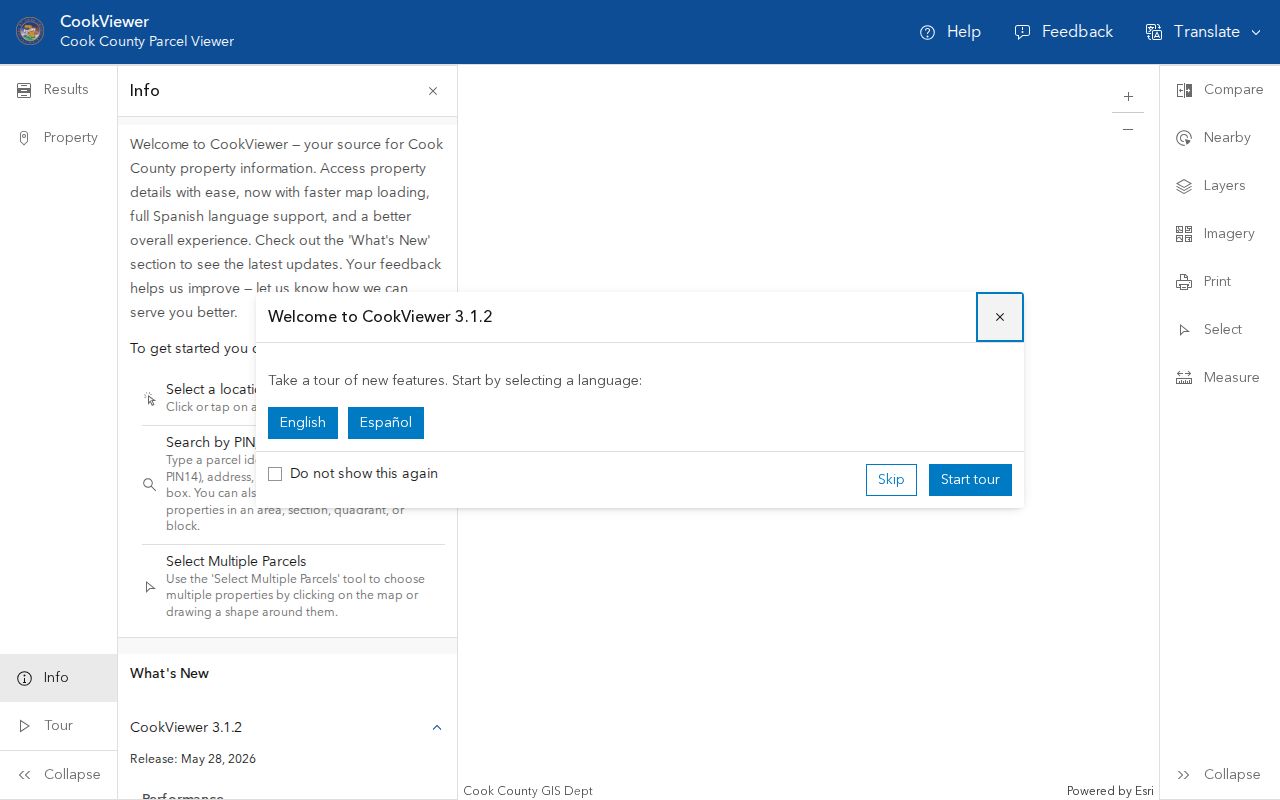
The parcel view keeps city limits, postal labels, tax records, and household claims from being blended into one unsupported answer.
Note: A map identifies land and boundaries, while a deed identifies parties to a transaction; neither lists every current occupant.
Current Des Plaines Resident Rolls
Current Des Plaines directories are really several official rolls with different purposes. Property systems identify parcels and owners. The recording index names parties to filed instruments. The voter lookup confirms a registration only after the user supplies several matching facts. Court dockets, business filings, and professional licenses can confirm a public role, but none of them should be treated as a complete household list.
| Source | Who It Lists | Keeper | Access |
|---|---|---|---|
| Assessor property card | Parcel owners and tax facts | Cook County Assessor | Free online; counter help |
| Registration lookup | A supplied voter's match | Illinois State Board of Elections | Free verification form |
| Recording index | Parties to deeds and liens | Cook County Clerk | Online index; counter and older books |
| City department directory | Public staff contacts | City of Des Plaines | Free online |
| Chamber directory | Member businesses and contacts | Des Plaines Chamber | Public member directory |
A name should be checked against role, date, and location. The Des Plaines resident lookup shows how to separate a parcel owner, a court party, a registered agent, and a person who may actually be connected to the address.
Verify Des Plaines Voter Records
The Illinois State Board of Elections lookup is a match tool, not a public browseable roll. It requires first and last name, date of birth, five-digit ZIP, street number, and a street name chosen from a dynamic list. A failed match may reflect an old ZIP, a shortened street name, number formatting, or a different election authority. It does not prove that the person is absent from Des Plaines.
Illinois law restricts the statewide voter file to statutory election and National Voter Registration Act purposes. Sensitive fields do not become a general resident directory. Protected voters and Address Confidentiality Program participants need added care.
The state registration form is shown in the captured image.
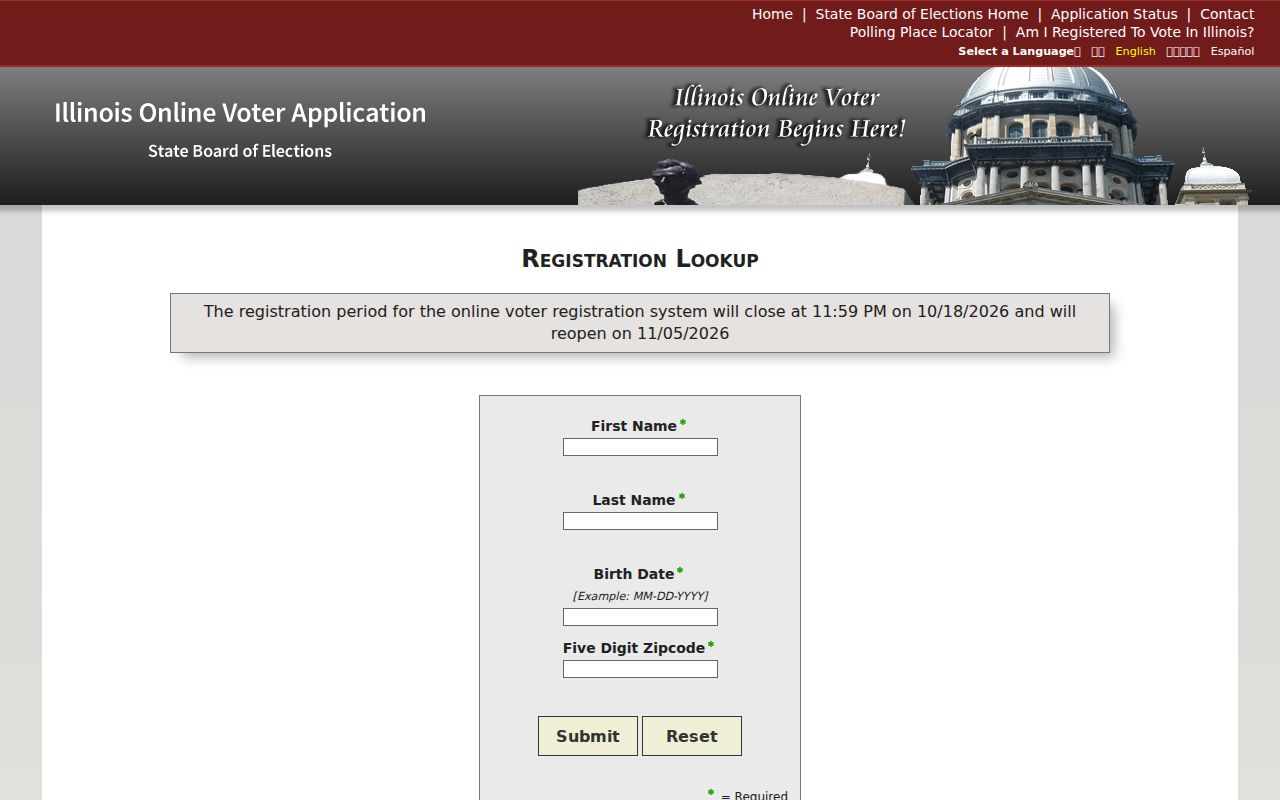
The number of required fields makes the service good for confirming known facts and poor for open-ended name hunting.
Follow Des Plaines Deed Names
The Cook County Clerk recording portal searches grantors, who give or transfer an interest, and grantees, who receive one. It also supports document type, recording date, legal description, wildcard, Boolean, and OCR text searches. The index can connect a name to deeds, mortgages, liens, releases, and plats, but the party's role matters. A trustee, company officer, attorney, or lien claimant is not necessarily a resident.
No single official start year was found for every online document. For a complete chain, use the recording search help, then contact the Clerk for deed books, tract indexes, microfilm, or Torrens material missing from the web. Recorder of Deeds duties moved to the Clerk in 2020, so an older citation to the Recorder still points to today's Clerk route.
- Index
- A finding aid that points to a filed record.
- Grantor
- The party transferring an interest.
- Grantee
- The party receiving an interest.
- Parcel
- A mapped unit of land identified by a PIN.
Check Des Plaines Court Names
The Cook County Odyssey portal offers Smart Search by party name and case number. A result can show a case number, caption, party role, filing date, type, events, hearings, and disposition clues. The Circuit Clerk warns that the electronic docket may lag and is not the official court record. Use a courthouse terminal or request the file when accuracy depends on the complete docket or an image.
The captured Cook County court search shows the public entry point.
Confirm the case type, dates, party role, and another identity field before linking a common name to a Des Plaines resident.
Request Des Plaines City Records
The Des Plaines City Clerk is the keeper of City Council proceedings, ordinances, resolutions, agreements, notices, and the Public Records Archive. Search posted meeting material first. For a permit history, code file, administrative hearing, or other municipal record not online, use the City FOIA page. Requests may be sent through the stated online, email, mail, drop-off, or in-person channels. Ordinary written requests generally receive a response within five business days under the Illinois Freedom of Information Act, subject to lawful extensions and special request rules.
The manifest capture comes from the Des Plaines FOIA and transparency page.
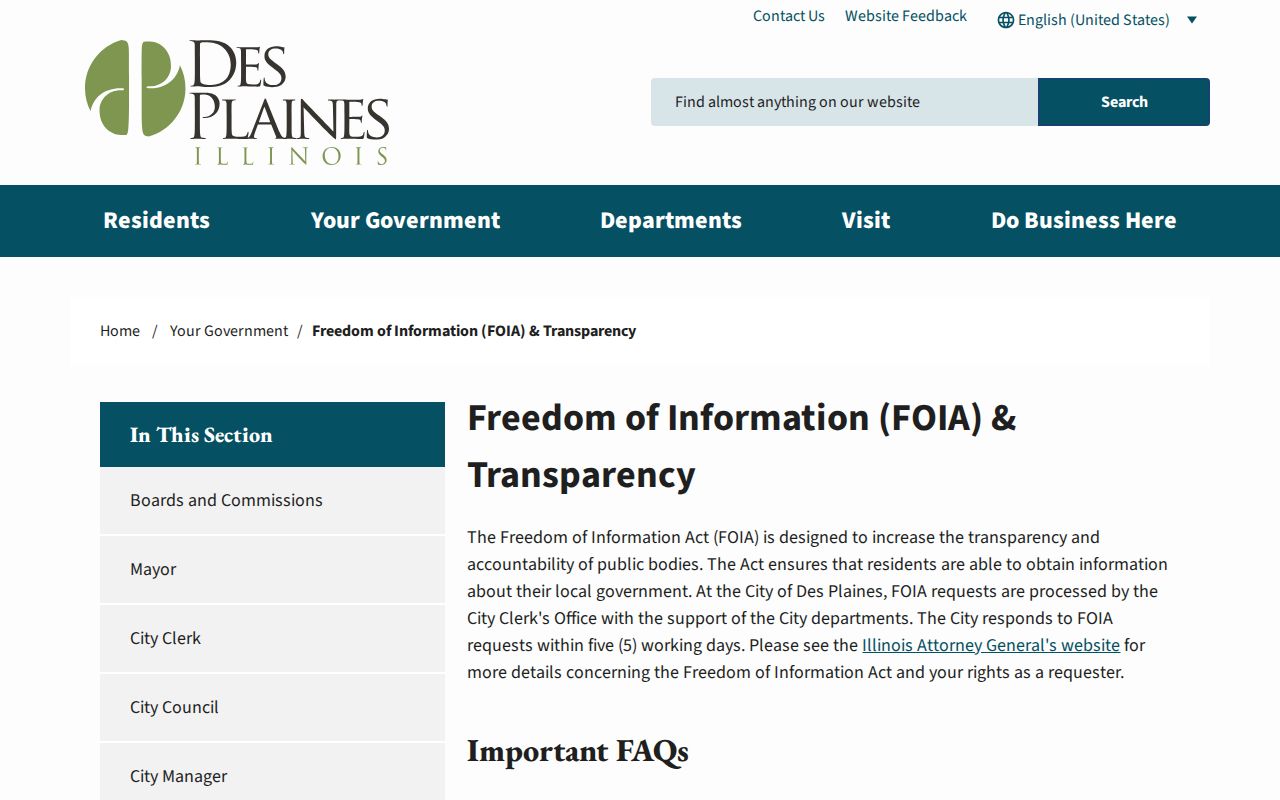
City Hall is the fallback for local files, while county and state records must still go to their own custodians.
Use Des Plaines Records Safely
Official records are more useful than commercial people-finder reports because the source, date, field, and correction path can be checked. Commercial tools may merge names, retain old addresses, or hide key detail behind a fee. They remain secondary leads, never proof of identity, ownership, residence, or a court outcome.
| Source type | Best use | Main limit |
|---|---|---|
| Official index | Confirm a dated public filing | May omit the document image |
| Custodian copy | Read or certify the actual record | Fees or eligibility may apply |
| Commercial compilation | Generate a lead to recheck | May be stale or merged |
Lawful use only. Des Plaines records may support family history, estate work, civic research, and personal safety. Never use them to stalk, harass, threaten, or harm anyone.
Protect Des Plaines Address Privacy
The Illinois Attorney General's Address Confidentiality Program provides a substitute-address and mail-forwarding route for eligible survivors of domestic violence, sexual assault, human trafficking, and stalking. Public record searches should respect protected addresses and redactions. The Attorney General warns that enrolling does not guarantee that a property record will be hidden, so participants should get program guidance before buying property or assuming a county index can be suppressed.
A correction request belongs with the custodian that published the field. Contact the Assessor or Clerk about a parcel or recording entry, the election authority about registration data, and the Circuit Clerk about a docket. Removing a commercial listing does not erase its government source. It may also need to be repeated when the commercial database refreshes.
Decode Des Plaines Address Gaps
An old Des Plaines address can fail in a modern portal even when the record is sound. City numbering follows an 800-per-mile and 100-per-eighth-mile framework, with adjustments assigned by the city. Annexed places and older labels, including Orchard Place or Farwell, Riverview, and Maine Township, can also move a search into a different index or era. Use a plat, neighboring landmark, street image, or legal description to bridge the gap.
The “On the Streets of Des Plaines 1915” collection in Des Plaines Memory can act as a visual proxy map. Compare signs, businesses, rail features, the river, Miner Street, and nearby buildings with the present parcel. That local check is especially useful when a historic directory number will not resolve in CookViewer.
Note: Preserve both the wording and year of an old address before testing a modern spelling or number.
Browse Historical Des Plaines Directories
Des Plaines Public Library holds city directories and telephone books with real gaps, plus local newspapers, obituary resources, FamilySearch affiliate access, and local-history material. Des Plaines Memory adds digitized photographs, postcards, letters, diaries, school records, business material, and the “On the Streets of Des Plaines 1915” collection. The Des Plaines History Center accepts research requests and gives another route to archives, photographs, and artifacts.
A city directory entry may list a householder, spouse, occupation, employer, and address, while a criss-cross volume reverses the order so a street address leads to a name. Confirm the abbreviation key and year before drawing a conclusion. The full shelf, its gaps, and the household-across-years method belong to the Des Plaines city directory reference.
Rail service beginning in 1857, later annexations, postwar growth, and changing place labels such as Orchard Place, Farwell, Riverview, and Maine Township can shift where a Des Plaines family appears. The Great Chicago Fire also destroyed original 1871 Cook County marriage licenses, making the Sam Fink Index and IRAD microfilm an important workaround.