
Which Des Plaines Sources Reveal Previous Residents?
No single register supplies a full occupant list for one Des Plaines property. Modern parcel records establish the PIN and legal description, recorded instruments follow title, and library or archival sources supply household context. The dates below decide where a search should begin.
| Source | Years Covered | Where Held | Evidence Found |
|---|---|---|---|
| Deed and document books | Scanning described for 1871-1959; exact online start unverified | Cook County Clerk, books, microfilm, IRAD | Title parties, transfers, legal descriptions |
| Des Plaines directories | 1970-75, 1977-94, and current; Haines 1994-current | Des Plaines Public Library | Listed names and addresses, depending on volume |
| Telephone books | 1940-41, 1943, 1949, 1951, 1956-60, 1962-current | Des Plaines Public Library | Telephone and address clues, with gaps |
| Federal census | Released schedules through 1950 under the 72-year rule | NARA and library databases | Household, ages, birthplace, occupation, census geography |
| Local newspapers | Scattered Suburban Times dates from 1914; Journal runs through 2020 with gaps | Library microfilm and databases | Moves, deaths, weddings, civic and business context |
| City hearings and permits | Hearings since June 6, 2002; permit start unverified | City departments, DP311, FOIA | Work, inspection, compliance, applicant and address clues |
For a recent property, save the modern parcel first. For a mid-century household, begin at the library shelf. For an older title, expect the Cook County Clerk, microfilm, and IRAD to matter because the official online beginning year was not established.
Save the Des Plaines PIN Before Going Back
A street number is a useful clue, but the parcel identification number and legal description make a firmer bridge across time. Search the current address in CookViewer and the Cook County Assessor, then copy the PIN, parcel boundary, subdivision, lot, block, property-location string, and tax-mailing address into separate notes.
The distinctions matter. The Assessor's property location is not a legal or postal address. A tax bill may go to a trust, agent, lender, or owner elsewhere. Neither field proves who slept in the building. They identify the parcel that later deed, directory, and census research must test.
Note: If CookViewer returns several properties within about 100 feet, use the PIN and mapped boundary to choose the right parcel.
Walk a Cook County Deed Chain Backward
The Cook County Clerk now performs the former Recorder of Deeds role. Its recording portal can search grantors, grantees, dates, document types, and legal terms, yet the research did not verify one exact online start year. A complete chain may therefore cross the web index, the Clerk's older books or microfilm, and archival routes.
- Pull the current title clue, PIN, and legal description from the Assessor or property-information portal.
- Search the current owner as grantee and identify the deed by document number, recording date, grantor, instrument type, and legal description.
- Take that grantor's name and search it as an earlier grantee. Try initials, entity names, trusts, estates, Boolean terms, wildcards, and a useful date range.
- Repeat the grantor-to-prior-grantee turn. When a street number fails, move to subdivision, lot, block, tract, book/page, or the legal description.
- For records beyond the online reach, ask the Clerk for books, tract indexes, microfilm, Torrens material, or an IRAD route.
The official grantor and grantee search help shows how name order, wildcard, Boolean, date, document-group, legal-description, and OCR searches work.
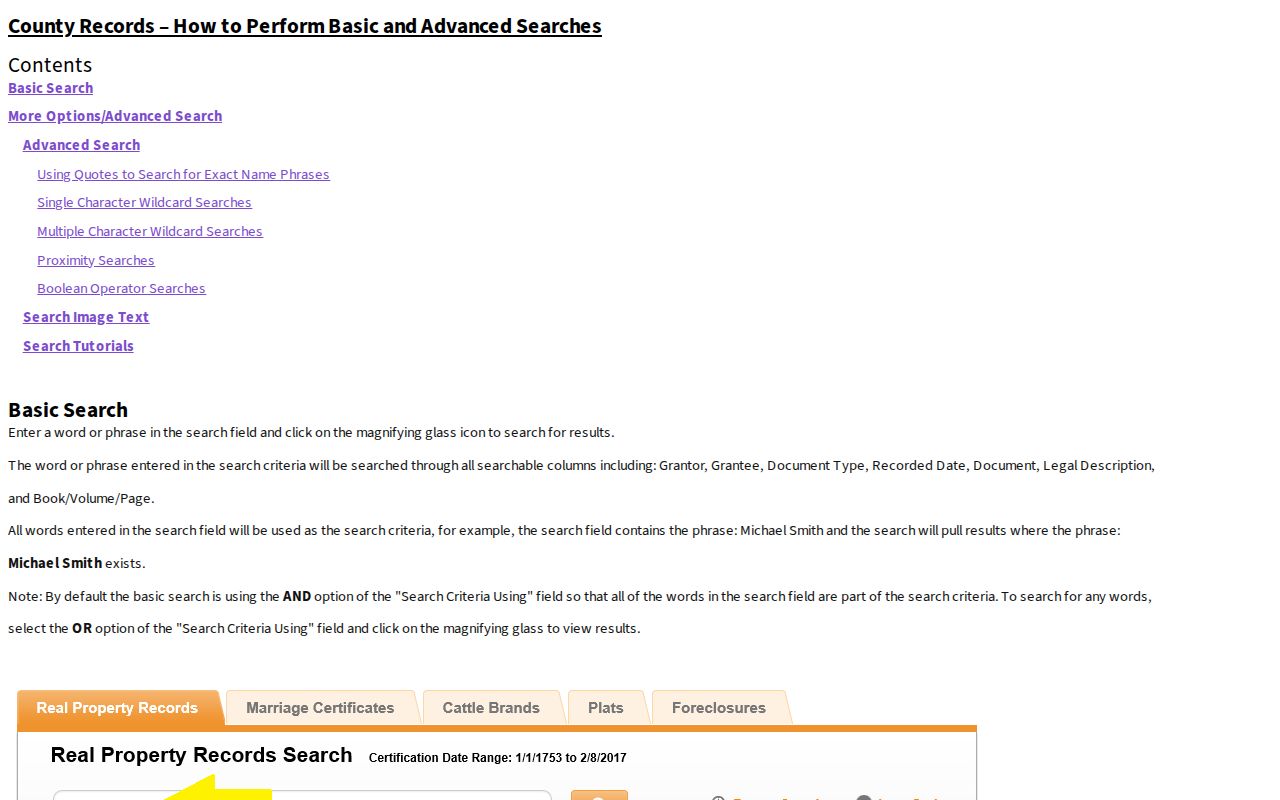
This captured help screen is the practical guide for changing a current deed party into the next earlier title lead.
- Grantor
- The party conveying an interest in the recorded instrument.
- Grantee
- The party receiving that recorded interest.
- Chain of title
- The linked sequence of conveyances affecting the same parcel.
- Legal description
- The lot, block, tract, subdivision, or other land wording that survives address changes.
Why Cook County's Paper Trail Still Counts
The county recording inventory gives scale to the offline fallback. Research identifies seven tract-index books, 4,047 tract books, 894 grantor/grantee books, 991 plat books, plus DD-214 and Torrens jackets. Those holdings explain why a blank web result cannot settle whether an older instrument exists.
Recorder functions transferred to the Cook County Clerk on December 7, 2020, so older guides may still direct a researcher to the Recorder of Deeds. Use the current Cook County Clerk recordings office, describe the parcel and desired date span, and ask which index, book, warehouse record, or microfilm route applies. Index presence also does not mean that a free image or certified copy is available.
When a Des Plaines House Number Moves
Des Plaines street numbers follow a municipal grid rather than one countywide system. North-south streets are numbered from a line across sections 16, 17, and 18 of Township 41 North, Range 12 East, while east-west streets begin from the west line of sections 18 and 19. The code uses 800 numbers per mile and 100 per one-eighth mile, with even and odd sides.
The Community Development director may assign, adjust, or reassign numbers. An old directory miss can therefore reflect a changed number, renamed street, subdivision, annexed area, or different geographic label instead of a missing household. Compare the legal description, PIN lineage, lot and block, plats, nearby landmarks, and any old-to-new street guide before abandoning the trail.
Orchard Place or Farwell, Riverview, Maine Township, Rand, village, and city labels can all appear across different Des Plaines record eras. County sources predate the modern municipality, while Orchard Place entered Des Plaines through annexation in 1956.
Pair Des Plaines Directories With Census Years
A deed follows ownership, not every occupant. To locate past residents, compare the address section of a reverse or criss-cross directory with the alphabetical name section, then place that listing beside the closest released census, newspaper item, and deed date. The collection details and shelf gaps are covered more fully on the Des Plaines city directory page.
- Choose a directory year near a transfer, permit, marriage, or death date and check the address listing.
- Find each listed name in the alphabetical section for initials, occupation, spouse, telephone, or owner-renter marks when the volume provides them.
- Move to the nearest released census schedule and account for its census-date snapshot, township, ward, and enumeration geography.
- Compare ages, occupations, birthplaces, surnames, and neighbors, but keep spelling variants and directory publication lag in view.
- Use newspapers, obituaries, probate, and permits to test moves or household changes between those snapshots.
Federal schedules are public on a rolling 72-year rule, with 1950 the latest released census as of the research date. More recent households cannot be reconstructed by assuming a title party, tax addressee, or voter match represents everyone at an address.
See Des Plaines Streets as They Looked in 1915
Des Plaines Memory adds a visual layer that deeds cannot. Its "On the Streets of Des Plaines 1915" collection includes street views, buildings, businesses, signs, and people. The broader archive holds photographs, postcards, letters, diaries, artwork, manuscripts, school material, business collections, and wartime items from the 1800s forward.
A caption is a lead rather than final proof. Match a building form, sign, school, rail line, or business to the parcel and then verify the date or person in a directory, newspaper, deed, or the holding institution's original metadata. The Des Plaines History Center at 781 Pearson Street also takes research requests and offers archive access during posted hours or by appointment.
Maps, Permits, and the Shape of a Des Plaines House
The Chicago History Museum house-history guide recommends directories, telephone books, census schedules, street-number changes, newspapers, photographs, clippings, and people files. The Library of Congress has a Sanborn map collection, but no Des Plaines sheet and year were verified during research, so a local search or library query is safer than claiming coverage.
City permits can date a demolition, roof, driveway, fence, addition, utility, sewer, pool, or other work. Current applications run through Customer Self Service, while DP311, Community and Economic Development, and city FOIA are the fallback for address-specific public material. No public field-level history search or complete start year was found. A contractor or applicant still does not prove residence.
Close a Previous-Residents Trail With Life Events
Obituaries and probate can explain why a household disappears after a directory year. Des Plaines Public Library offers local newspaper microfilm and databases, including long but incomplete Suburban Times and Journal runs. A targeted name and date request can go to the library reference desk. Cook Circuit Clerk probate files, IRAD probate holdings, and History Center research can add an executor, heir, death, or former-address clue.
Naturalization may add a different endpoint or identity check. NARA Chicago's naturalization guide covers federal Northern District of Illinois holdings from 1872 through 1991 and Soundex material, while warning that naturalization could occur in more than one court.
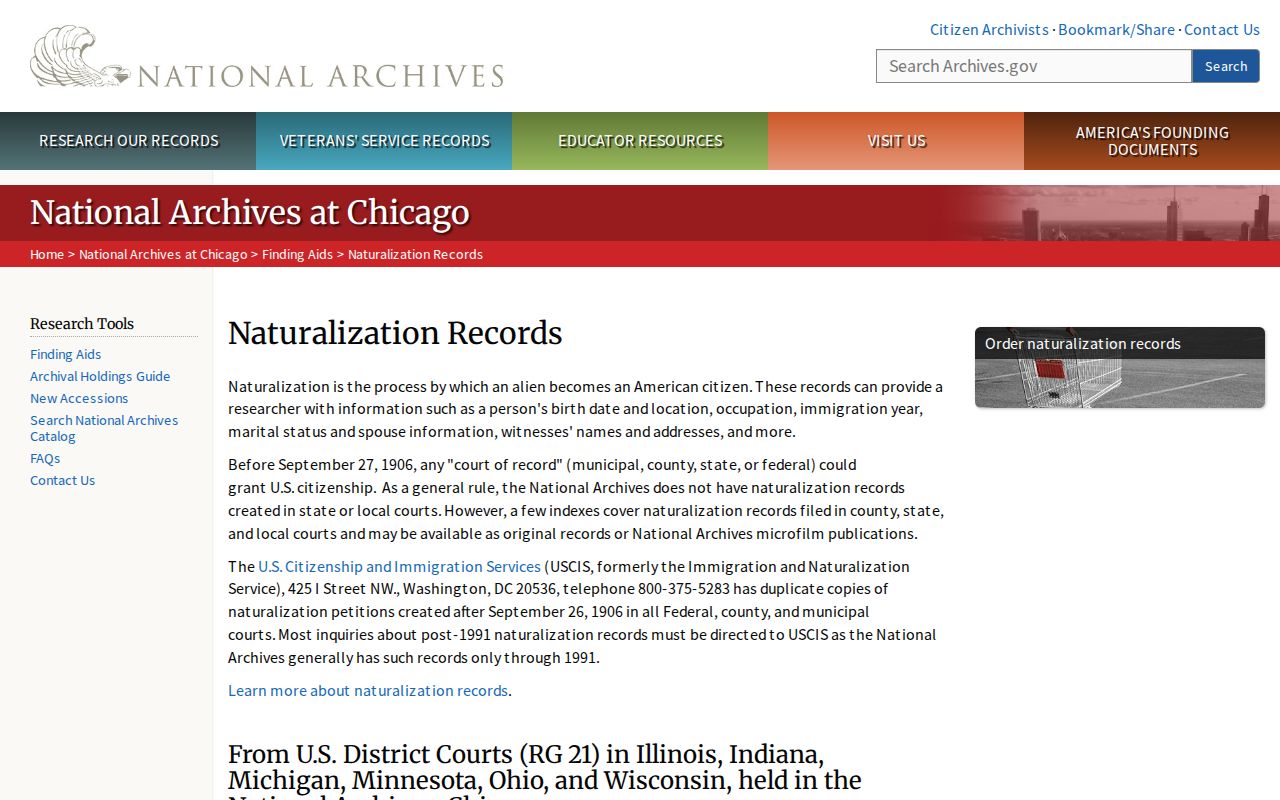
The captured NARA page marks an archival route for identity and migration context when local address sources reach their limit.
The 1871 Chicago Fire also destroyed original Cook County marriage licenses. The Sam Fink Index copy on microfilm at IRAD-NEIU is the documented workaround, another reason not to treat a missing online record as the end of a Des Plaines search.
Lawful use. Research previous residents for house history, family history, and personal curiosity. Never use a living person's details to watch, harass, intimidate, or cause harm.