
Confirmed Des Plaines Directory Shelf
The Des Plaines Public Library genealogy collection is the first stop for the local printed-directory run. A 1999 official Illinois library-resource inventory confirms Des Plaines volumes for 1970 through 1975 and 1977 through 1994, then listed as current. Haines directories begin in 1994 and were also listed as current. The same inventory names Donnelley separately but does not supply a complete run, so the publisher and today’s shelf should be confirmed with reference staff.
| Collection | Confirmed years | Where held | Access |
|---|---|---|---|
| Des Plaines printed directories | 1970-1975; 1977-1994/current in 1999 | Des Plaines Public Library | Library shelf or staff request |
| Haines directories | 1994-current in 1999 | Des Plaines Public Library | Confirm current reverse format |
| Des Plaines phone books | 1940-1941, 1943, 1949, 1951, 1956-1960, 1962-current in 1999 | Des Plaines Public Library | Library use; gaps remain |
| Local visual collections | 1800s to present, item dates vary | Des Plaines Memory | Free online search |
No official page showed a fully digitized printed directory run or a legible sample entry. Ask the library for a shelf check or scan instead of treating a digital photograph collection as the books themselves. Historical address research can then move to the modern Des Plaines street records for the current parcel.
Review the library’s genealogy and local history access page before requesting a volume.
The captured page identifies the current library gateway even though the detailed shelf years come from the older state inventory.
Des Plaines Phone Books Fill Gaps
Phone books reach farther back than the confirmed Des Plaines printed directories. The verified shelf has early volumes from 1940 and 1941, then scattered years in the 1940s and 1950s, a 1956 through 1960 run, and 1962 forward as described in 1999. They can provide a listed subscriber, number, and address when a city directory year is missing.
A phone listing is not equal to a full household. Unlisted numbers, shared lines, name initials, and business entries can obscure a person. Search spouse and initial variants, then compare the address with a nearby annual volume, newspaper notice, deed, or census. The missing 1976 year in the confirmed directory run makes this cross-check especially useful.
Current local newspaper runs offer another bridge. The library lists Des Plaines Day for incomplete 1968 and 1969 issues, the Journal for 1964-1974 and 1976-2020, and the Suburban Times across scattered and long runs from 1914 through 2001. Reference staff accepts local newspaper questions at 847-376-2841 or ReferenceServicesDesk@dppl.org.
Read a Des Plaines Directory Entry
Historical directory entries use compressed type. The actual Des Plaines page and abbreviation key were not available in official online sources, so each symbol must be checked in the volume. Common directory anatomy provides a checklist, not permission to invent a sample person.
| Name | Surname, given name, or initials; spouse may be in parentheses |
|---|---|
| Work detail | Occupation and sometimes the employer or business address |
| Home detail | Street address, telephone, or residence notation |
| Status mark | Widow, boarder, owner, or renter only where that publisher defines it |
| Cross-reference | Street-order entry or business listing elsewhere in the book |
- Criss-cross directory
- An address-order section that moves from street number to a listed name.
- Householder index
- An index centered on the person identified as the main listed householder.
- Abbreviation key
- The publisher’s legend defining shortened words and marks; copy it before reading entries.
A directory entry records a publisher’s listing at one point in time. It does not prove every household member or the legal owner. Photograph the title page, coverage statement, and key with the entry so the citation remains clear.
Reverse Des Plaines City Directory Searches
A later reverse or criss-cross volume may be searched by street and number. Once a name is found in the address section, turn to the alphabetical section for initials, spouse, work, or phone details. Then search a year before and after. This two-way method catches spelling changes and distinguishes people with the same surname.
Confirm the current shelf’s reverse format with library staff. The 1999 resource list establishes Des Plaines and Haines directory runs but does not expose their page arrangement online. If the house number fails, check the city’s old-new numbering guide and parcel legal description. A renamed street or annexed place can break a literal search.
Town of Rand is an early clue: the subdivision took the Des Plaines name in 1869. Orchard Place, formerly Farwell, was annexed in 1956. Maine Township can appear in census, school, and county indexes even when the address is now treated as Des Plaines.
Des Plaines Memory Shows 1915 Streets
Des Plaines Memory holds photographs, postcards, letters, diaries, manuscripts, school and business material, and street views. Named groups include City of Destiny, Greetings from Des Plaines, Maine Township Schools, We Mean Business, and On the Streets of Des Plaines 1915. Search captions and item metadata for a street, school, shop, or landmark before returning to a directory volume.
Explore the assigned Des Plaines Memory collection alongside the printed shelf.
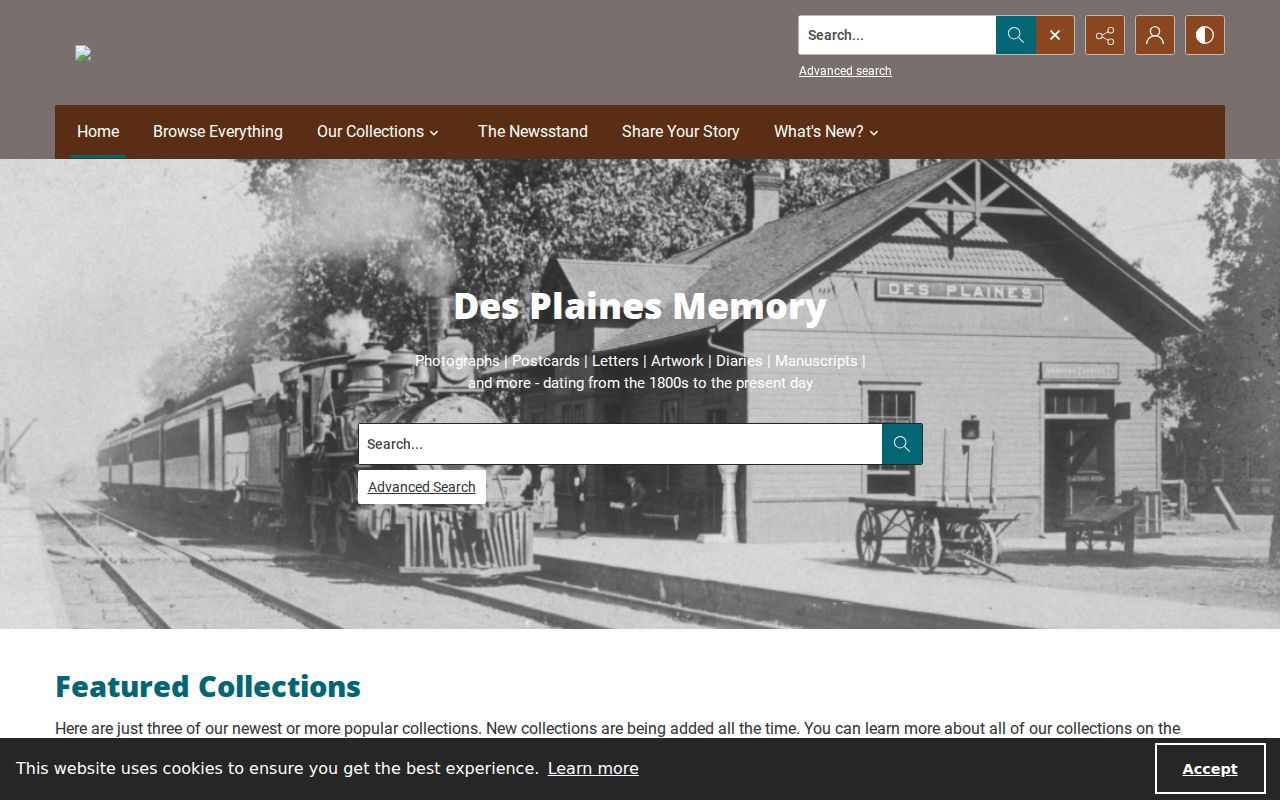
The digital archive provides visual context for an old entry, but it is not a scanned series of printed directories.
The 1915 street collection works as a proxy map. A captioned storefront, school, or intersection may reveal that the built setting or street number changed. Compare that clue with the old volume, newspaper, city numbering record, and modern parcel geometry.
Des Plaines History Center Fallback
The Des Plaines History Center holds archives, photos, artifacts, and research files. It accepts research requests at 781 Pearson Street, 847-391-5399, and contact@desplaineshistory.org. Published hours are Monday through Friday, 10:00 to 4:00, by appointment, plus second Sundays from 10:00 to 2:00. No exact research fee was stated.
Open the Center’s research service page before sending a focused name, street, date range, and known source.
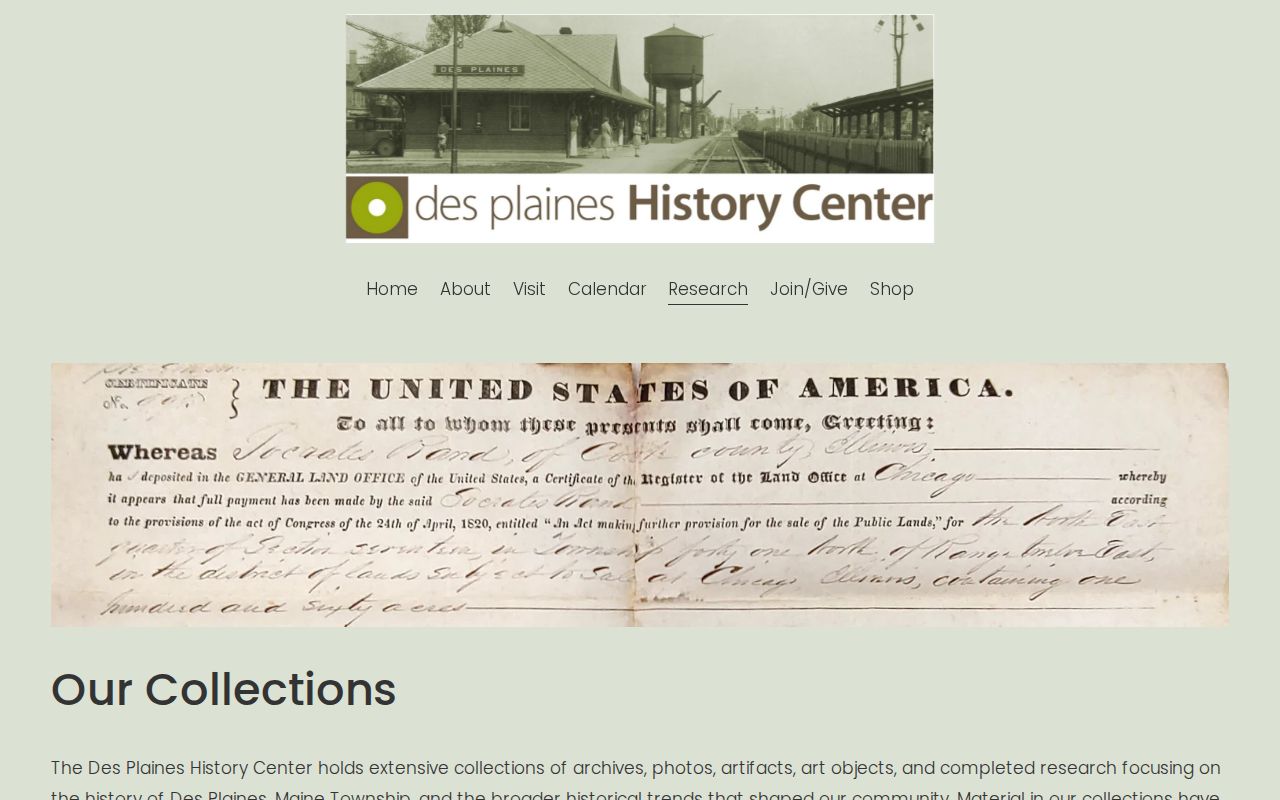
The image identifies the direct request channel for original local material that is not searchable online.
If local shelves have a gap, the Chicago History Museum house-history guide recommends phone books, census, address directories, old-new street-number guides, newspapers, photos, and people files. IRAD at Northeastern Illinois University adds Cook County land, court, probate, naturalization, tax, and vital record groups. NARA Chicago holds federal Northern District naturalization material from 1872 through 1991, though it is not the full local-court universe.
Newspapers Extend Des Plaines Directories
A directory disappearance can mean a move, death, unlisted entry, or a name change. Newspapers can separate those paths. An obituary may give relatives, a former address, church, funeral home, or death date. Wedding, business, and public notices may explain a surname or address shift. Verify each newspaper claim against a vital, probate, deed, or later annual directory record.
The Abraham Lincoln Presidential Library’s Illinois newspaper list distinguishes the Community Budget Balancer, Journal, and Suburban Times runs. DPPL also provides historical Chicago Tribune coverage from 1849 through 2001, later full text, and other news tools. Use the library’s reference service for local microfilm rather than assuming every issue has a public web image.
Church, cemetery, funeral-home, veterans, and civic files can help when a family vanishes from the main series. No city-run Des Plaines interment search or public organization membership roster was found, so request legitimate historical access from the institution.
Trace Families Through Des Plaines Directories
Follow a household year by year and pair city directory evidence with the nearest released federal census. Census schedules open after 72 years, and older geography may describe Maine Township or a nearby place rather than today’s city boundary.
- Start with a known name, year, and street, then check spelling, initials, and spouse forms.
- Search the alphabetical entry and any address-order section in the same volume.
- Move one directory year at a time, recording addresses, work, phone, and widow notation.
- Compare the nearest released census for household members, ages, work, and immigration facts.
- Close a gap with newspapers, deeds, probate, History Center files, or Des Plaines Memory images.
Do not treat absence as proof. Publication gaps, unlisted phones, a move between editions, and a changed street number are all possible. Name variants matter in a city shaped by several migration waves, including German immigration in the nineteenth century and later international growth.
Cook County Fire-Era Record Gaps
Cook County’s original marriage licenses were destroyed in the Great Chicago Fire of October 8 through 10, 1871. The Sam Fink Index copy on microfilm at IRAD-NEIU is a historical workaround. That story is a useful rule for city directory work: an absent original or online result may still have a finding aid, reconstruction, microfilm copy, church entry, newspaper notice, or alternate custodian.
Cook County predates the modern city, and municipal labels changed from Rand to Des Plaines, town to village, then city in 1925. Riverview was annexed that year, and Orchard Place followed in 1956. Search the record-keeping era that existed when the event occurred rather than forcing a current label onto an older source.
No official source identified the first Des Plaines city directory or the exact last printed year. The responsible route is to ask DPPL for the current shelf and publisher details, document the answer, and preserve gaps rather than fill them with guesses.